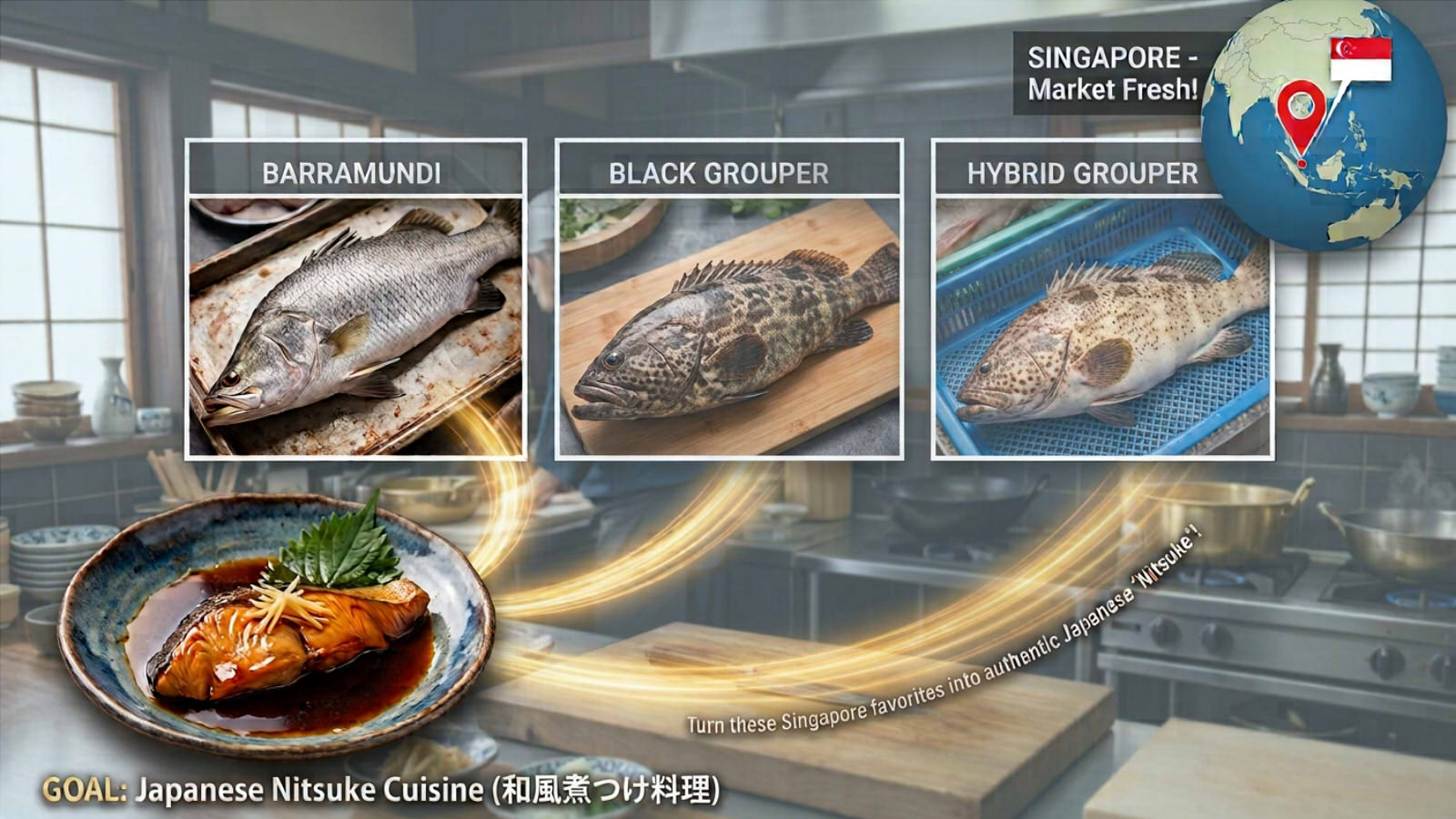
When looking at my blog’s analytics recently, I noticed something wonderful: a significant portion of you reading these posts are visiting from Singapore. As a home cook living in Japan, this discovery made me deeply curious about what your daily grocery shopping looks like, and how Japanese cooking techniques might fit into your local kitchen reality.
I want to be completely transparent with you from the start: I have never been to Singapore, nor have I tasted local Barramundi or Grouper myself. I am certainly not an expert on Singapore’s seafood scene! However, out of a genuine desire to offer something practical for your everyday meals, I started researching the fresh fish available in your local wet markets and supermarkets. Two specific catches immediately caught my eye: Barramundi and Grouper.
Why Nitsuke is My Favorite “Gateway Okazu“
When people first explore Japanese home cooking (Katei Ryori), they often start with well-known dishes like pork ginger (Shogayaki) or beef bowl (Gyudon). While those meat dishes are delicious, I have always considered Nitsuke (fish gently simmered in a sweet-savory dashi) to be the ultimate “gateway Okazu” for unlocking Japanese culinary philosophy.
To clarify, if you ask a Japanese native what the absolute classic, traditional Nitsuke fishes are in Japan, the answer is usually Karei (Flounder) or Madai (Red Sea Bream)—with Gindara (Sablefish / Black Cod) acting as a richer, higher-end special choice. Suzuki (Sea Bass) isn’t necessarily a classic daily choice, but when cooked as Nitsuke, it offers a surprisingly delicious, delicate white-fish texture similar to Tai.
Unlike Japanese meat dishes, a good Nitsuke relies heavily on the physical characteristics of the fish itself. You cannot simply ignore local fish accessibility—if the right type of fish is too expensive or hard to find, the barrier to cooking it at home becomes too high.
A Thought Experiment: Barramundi as an Accessible Suzuki Style Nitsuke
Looking at imported Japanese fish in Singapore, cuts of air-flew sea bream (Tai) or sea bass (Suzuki) can easily cost SGD $20 to $30 or more. To me, paying that much for an everyday family dinner feels unnecessarily high.
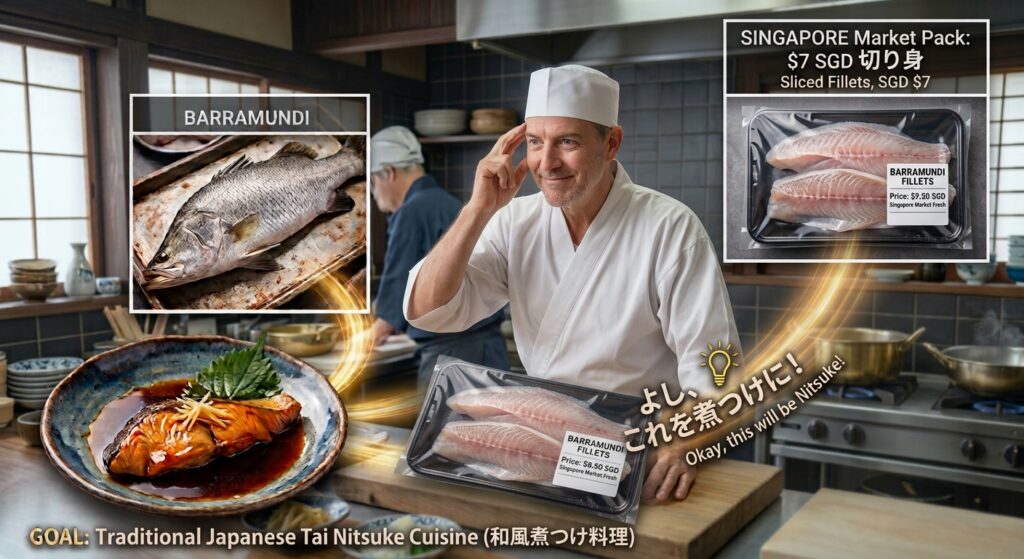
While researching your local market prices, I was excited to see fresh, skin-on Barramundi fillets available in the very reasonable SGD $6.50 to $8.00 range. Taxonomically, Barramundi (Asian Sea Bass) belongs to the same family (Latidae) as Japanese Suzuki.
While Suzuki Nitsuke isn’t the most common household standard in Japan, it makes a wonderful, elegant dish when cooked properly. Barramundi seems to share those same great qualities—offering a thick, clean 200g fillet that holds its shape gracefully in a simmering pan without drying out, making it feel like a very solid equivalent to a Tai or Suzuki Nitsuke.
Grouper: A Local Favorite with a Luxury Japanese Twin
In Singapore, I understand that Grouper is traditionally loved for Chinese-style steaming with ginger and scallions. But when I saw that standard Grouper fillets are readily accessible in your markets (around SGD $8.00 to $10.00 for a generous portion), my mind instantly went to Japanese Nitsuke.
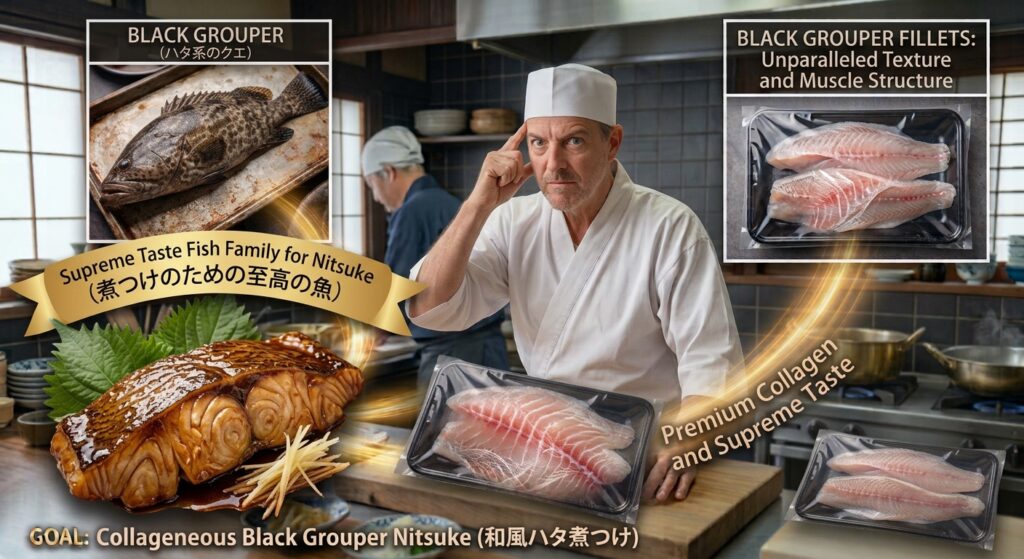
In Japan, fishes in the Grouper family—such as Kue (Longtooth Grouper) or Hata—are considered luxury wild catches, often reserved for high-end winter hot pots or specialized restaurant dishes. They are prized specifically for their skin, which is packed with rich, natural gelatin.
If you choose standard hybrid or black Grouper (rather than the pricier Red Grouper), you get that exact same gelatinous skin texture at an affordable price. As it simmers in a Japanese dashi, that skin should naturally thicken the braising liquid into a rich glaze without needing any starch.
Comparing 6 Fish Varieties for Nitsuke
To help visualize how these local Singapore catches compare against Japanese Nitsuke fishes in terms of fat content, texture, and pricing, I compiled this comparison guide:
| Fish Species | Fat & Richness | Meat Texture | Flavor & Characteristics | Est. Market Price (per kg) |
|---|---|---|---|---|
| Suzuki (Japanese Sea Bass) | ★☆☆ – ★★★ | Coarse fibers with a firm, solid bite. | Light and extremely lean. Can sometimes carry a muddy ocean aroma depending on season/water quality. | ~¥1,500 – ¥3,000 / kg |
| Madai (Red Sea Bream) | ★★☆ | Moist, dense, and flakes apart delicately. | Zero gaminess. Elegant Umami and sweetness expand as you chew. | ~¥2,000 – ¥4,000 / kg (Varies by wild vs. farmed) |
| Kinmedai (Splendid Alfonsino) | ★★★ | Meltingly soft and extremely juicy. | Deep, fatty richness with intense sweetness. The pinnacle of Nitsuke. | ~¥4,000 – ¥8,000 / kg (Luxury fish) |
| Barramundi (Singapore Farmed) | ★★☆ | Plump, soft, and large-yielding flesh. | Same genus as Asian Sea Bass. Lacks Suzuki’s muddy odor, featuring buttery richness and elegant sweetness. Holds shape well when simmered. | ~¥1,500 – ¥2,500 / kg (Local retail: ~$10–$14 for ~500g) |
| Black Grouper (Singapore Farmed) | ★★☆ | Firmly set with great elasticity and springiness. | Relative of Kue (Grouper family). Skin is rich in collagen, yielding a gelatinous texture and high-quality white fish umami when simmered. | ~¥3,500 – ¥5,500 / kg (Local retail: ~$38 for ~1kg) |
| Hybrid Grouper (Singapore Farmed) | ★★★ | Combines delicate tenderness with a chewy elasticity. | Crossbreed of Giant & Brown-marbled Grouper (Dragon Tiger Grouper). Exceptionally fatty among groupers; superb in dark, savory-sweet sauce. High-end staple in Chinese cuisine. | ~¥4,500 – ¥6,500 / kg (Local retail: ~$49–$58 for ~1kg) |
Re-evaluating Texture and Value: The Case for Okazu
Looking at the rating scale above, it is worth noting that a “2-star” rating for fat and richness represents an ideal benchmark rather than a compromise. In Japanese cooking, Madai (Red Sea Bream) sits at this exact 2-star level, offering a balanced, elegant flavor profile that pairs effortlessly with plain white rice. The fillets are easy to debone, flake cleanly onto your chopsticks, and absorb the braising sauce without becoming greasy.
Barramundi occupies this exact same balanced 2-star category. It provides a clean, substantial fillet at a very reasonable price point, yet in Singapore, it is predominantly prepared in Chinese styles.
The value proposition for Grouper is even more remarkable from a Japanese home cook’s perspective. In Japan, fishes from the Hata or Kue family are treated as premium delicacies. If a 300g fillet portion of Grouper were available at a Japanese supermarket in Singapore for around SGD $13 to $15, that would be considered a major special bargain (Tokubai level) by Japanese standards. Finding those same collagen-rich cuts in local Singapore markets for an even lower everyday price makes them a fascinating candidate for Nitsuke.
How to Make Nitsuke (My Casual Cooking Method)
If you’ve never made Nitsuke before and want to see the technique in action, I actually recorded a simple YouTube video a while back showing how I prepare it at home!
Fair warning: the production quality is pretty raw, and my narration is super casual! But if you want to see the exact dashi ratio, how gently the fish should simmer, and what that glossy sauce looks like in real time, feel free to give it a watch below. Just swap in your local Barramundi or Grouper fillets for the fish I used!
Let’s Test This Idea Together!
Because I am sharing this purely as an enthusiastic thought experiment from afar, I need your help to turn this idea into reality.
If you live in Singapore and try simmering local Barramundi or Grouper in a classic Nitsuke sauce (equal parts sake, mirin, water, and soy sauce with fresh ginger slices), I would be so grateful to hear how it turns out for you!
- Did the Barramundi hold its shape well in the pan?
- Did the Grouper skin create that glossy, rich glaze to pair with your rice?
- Are there other local white fishes in your neighborhood market that you think might work even better?
Please drop a comment below and share your kitchen findings. Your real-world feedback will help shape future recipes as we continue exploring how Japanese home cooking can gently adapt to local tables around the world.
Leave a Reply