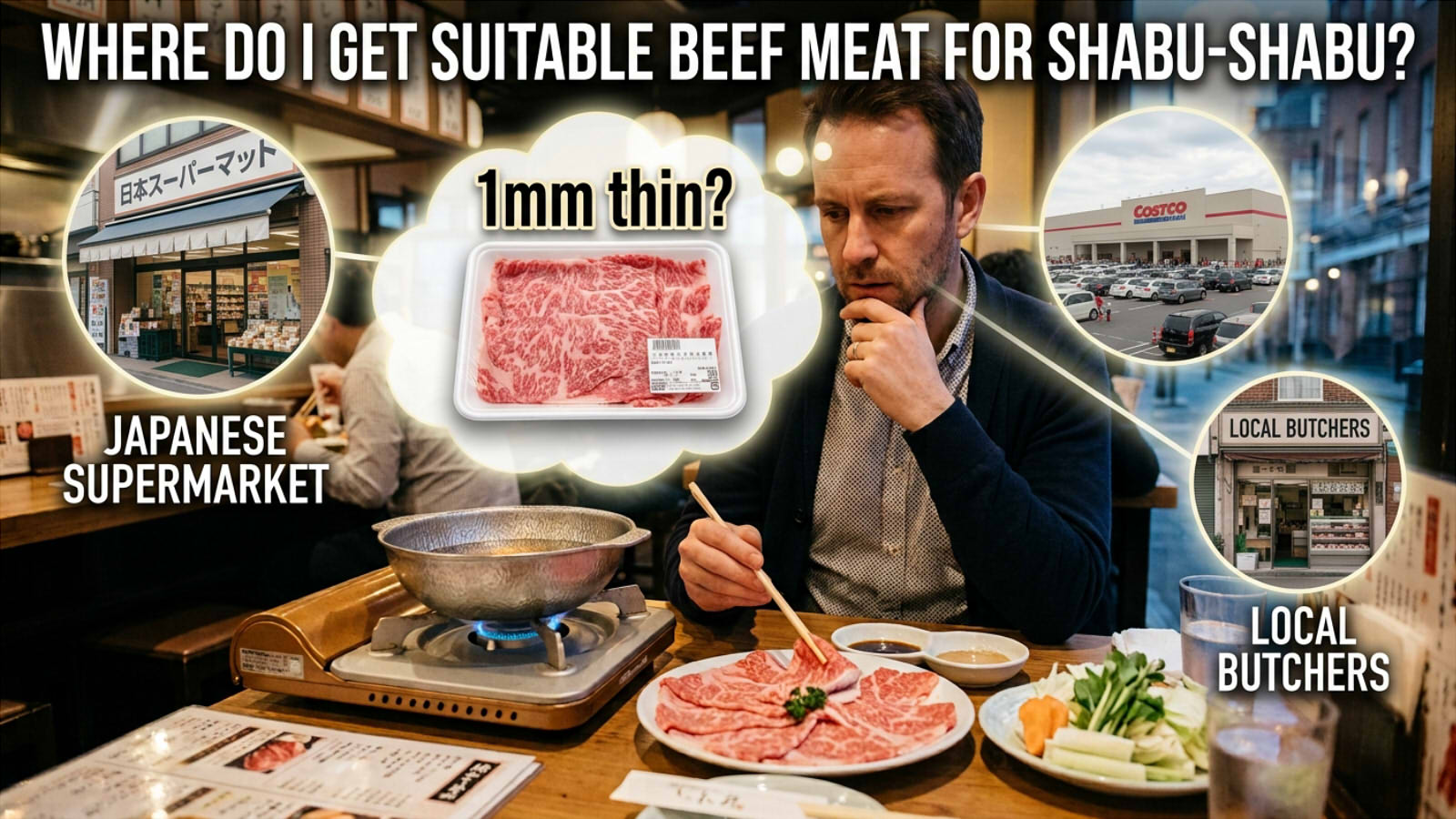
The single biggest factor determining whether your home Shabu-Shabu (しゃぶしゃぶ) succeeds or fails isn’t the broth—it’s the thickness, cut, and fat distribution of your beef.
Because Shabu-Shabu relies on a rapid “flash-poaching” technique (literally swirling meat in near-boiling dashi for just 3 to 5 seconds), ordinary steak cuts or thick hot-pot slices will turn rubbery and tough. In this second installment of our Shabu-Shabu masterclass, we break down how Japanese beef grades (Wagyu) compare to global standards, how to source the ideal paper-thin slices in different regions, and my personal practitioner recommendations for making Shabu-Shabu an everyday meal—wherever you live.
1. My Personal Stance: Thickness Over Trophy Grades
Many people assume Shabu-Shabu is an exclusive, ultra-expensive luxury reserved for high-grade Wagyu. As someone who eats Shabu-Shabu regularly as a staple everyday meal (okazu), here is my exact stance on meat quality vs. slice thickness:
- Grade A4 / A5 (High Marbling): The absolute ideal for tenderness and melt-in-your-mouth fat. Because the fat lowers the structural density, you can go slightly thicker—up to 1.5mm max (though 1.0mm remains the golden ideal).
- Grade A3 or Lower / Standard Imported Beef: If the meat is leaner or firmer, you must strictly stay between 1.0mm and 1.2mm. At 1.0–1.2mm, almost any fresh, decent-quality beef becomes tender and delicious through flash-poaching.
My Everyday Choice in Japan:
In standard Japanese supermarkets, my go-to choice for an everyday Shabu-Shabu meal is simple: imported US or Australian beef sliced at 1.0mm–1.2mm, priced around ¥250 / 100g (~$1.60 USD). You do not need expensive A5 Wagyu to enjoy incredible Shabu-Shabu on a Tuesday night. Freshness and thinness trump price every single time.
2. Table 1: Availability & Cost Comparison: Thinly Sliced Shabu-Shabu Beef
Use this quick regional reference guide to navigate local retail options and find the best strategic balance between price, thickness, and quality:
| Region / Target | Retailer / Supermarket Type | Availability & Cut Type | Slice Thickness & Quality | Approx. Price (USD Equivalent) | Strategic Advice for Readers |
|---|---|---|---|---|---|
| Japan (Expats & Local English Speakers) | Standard Supermarkets (OK Store, Life, Seiyu, Summit) | Ubiquitous (Everywhere) Fresh, unfrozen, pre-sliced packs (Chuck roll, Sirloin, Ribeye, Wagyu/Domestic). | 1.0mm – 2.0mm (Precision sliced daily, perfect for Shabu-Shabu). | $1.50 – $3.50 / 100g (¥220 – ¥500/100g for standard beef) $5.00 – $10.00+ / 100g (¥750 – ¥1,500+/100g for Kuroge Wagyu) | The gold standard. No special trip needed—every neighborhood supermarket carries ideal pre-cut meat daily at affordable prices. |
| Singapore | Local Supermarkets (NTUC FairPrice, Cold Storage, Sheng Siong) | High Availability Frozen rolls (Short Plate / Chuck Roll / US Grain-fed). | 1.5mm – 2.5mm (Machine-rolled for steamboat/hot pot). | $2.50 – $4.50 / 100g (SGD $3.50 – $6.00/100g) | Best Value: Local Asian/Steamboat frozen rolls at FairPrice are budget-friendly and widely available. |
| Singapore | Japanese Specialty (Don Don Donki, Isetan, Meidi-Ya) | High Availability Fresh or chilled sliced Wagyu, Australian, and US beef. | 1.0mm – 2.0mm (Authentic Japanese Shabu/Sukiyaki cuts). | $6.00 – $15.00+ / 100g (SGD $8.00 – $20.00+/100g for A4/A5 Wagyu) | Excellent quality, but carries a high import premium. Great for special occasions, but not required for everyday Okazu meals. |
| United States | Mainstream Retailers (Trader Joe’s, Kroger, Whole Foods) | Moderate / Limited Trader Joe’s “Shaved Beef Steak” or generic shaved beef. | 2.0mm – 3.0mm+ (Often irregular/thicker; designed for Philly Cheesesteak). | $2.20 – $3.30 / 100g (~$9.99 – $14.99/lb) | Budget Workaround: Trader Joe’s Shaved Beef works in a pinch, though slightly thicker. Alternatively, ask a butcher for a semi-frozen ribeye slice at setting #1. |
| United States | Asian Supermarkets / Delivery (H Mart, Mitsuwa, 99 Ranch, Weee!) | High Availability Frozen rolls (Short plate, Chuck roll, Angus, Wagyu). | 1.2mm – 2.0mm (Ideal hot pot / Shabu-Shabu thinness). | $3.00 – $6.00 / 100g (~$13.00 – $25.00/lb depending on cut) | Best Choice: Asian groceries (H Mart, 99 Ranch, or Weee! online delivery) offer authentic, paper-thin cuts specifically packaged for hot pot/Shabu-Shabu. |
3. Table 2: The Global Beef Grading Map at a Glance
Understanding beef quality standards across regions allows you to select the right cut without overpaying for excessive fat or settling for tough muscle:
| Country / Region | Grading System / Authority | Primary Grades (Highest to Lowest) | Comparison to Japan (JMGA) |
|---|---|---|---|
| Japan | JMGA (A1 – A5, BMS 1–12) | A5 (BMS 8–12) A4 (BMS 5–7) A3 (BMS 3–4) | Gold Standard for Marbling (A4/A5 is almost strictly domestic Japanese Wagyu). |
| United States | USDA Quality Grade | USDA Prime USDA Choice USDA Select | USDA Prime = Approx. Japanese A3 / Low A4 (BMS 4–5). The entire A5 tier sits way above the highest USDA grade. |
| Australia | AUS-MEAT (MS 0 to 9+) | MS 9+ (Near A5 equivalent) MS 6–8 (A4 equivalent) MS 3–5 (USDA Prime equivalent) | Direct BMS Parallel Scale tops out at 9+ (which covers Japanese BMS 9–12). |
| American / Crossbred Wagyu | Producer BMS Claims (BMS 1–12) | Gold Grade (BMS 8–9) Black Grade (BMS 6–7) (Varies by brand) | Cross between Japanese Wagyu & Angus. High marbling, but retains a “beefier” steak flavor. |
4. The Global Reality: What If Thin Beef Is Too Expensive or Hard to Find?
Looking at the sourcing options in the US or Singapore, it often feels like there are only two extremes: pay a steep premium for imported Wagyu, or skip Shabu-Shabu altogether.
My goal with this series is to make Shabu-Shabu an accessible, everyday cooking concept for everyone around the world—not a luxury reserved for high-end restaurants.
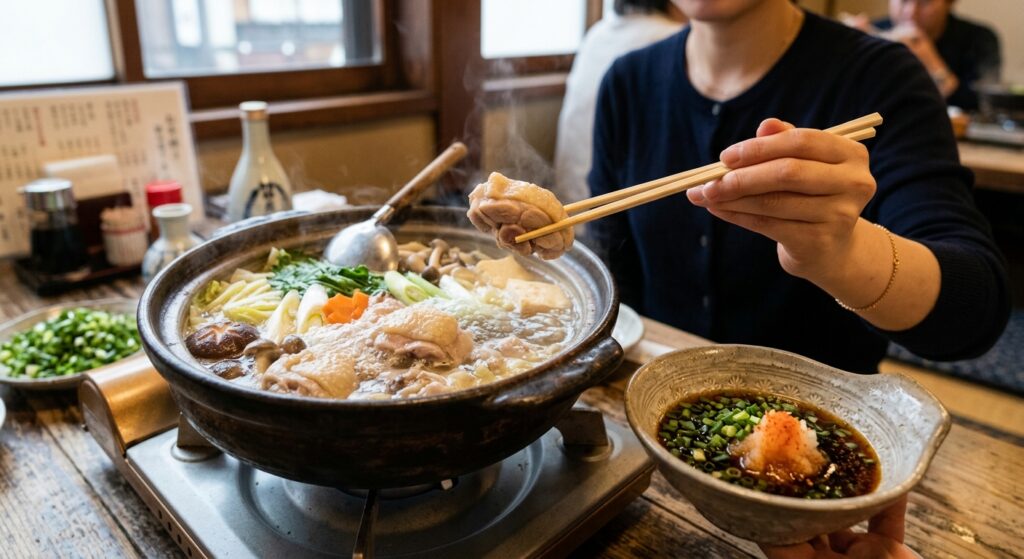
If you live in a location where 1.0mm sliced beef is overpriced or unavailable, don’t abandon the concept! You can fully experience the core philosophy of Japanese hot-pot dining—the clean broth extraction, flash-cooking technique, and dipping sauce pairings—using accessible proteins like thinly sliced chicken breast or thigh (Tori-Shabu / Mizutaki style).
Summary & Next Steps
Whether you choose affordable $1.0\text{mm}$ US beef slices or adapt the method with chicken, the core mechanics of Japanese flash-poaching remain identical.
In Post #3, we will explore how to apply these exact Shabu-Shabu mechanics using Chicken & Alternative Proteins, followed by our step-by-step masterclass on Homemade Citrus Ponzu & Goma-dare from scratch!
Leave a Reply